No products in the cart.

What Makes a System Enterprise-Grade?
29 Jun
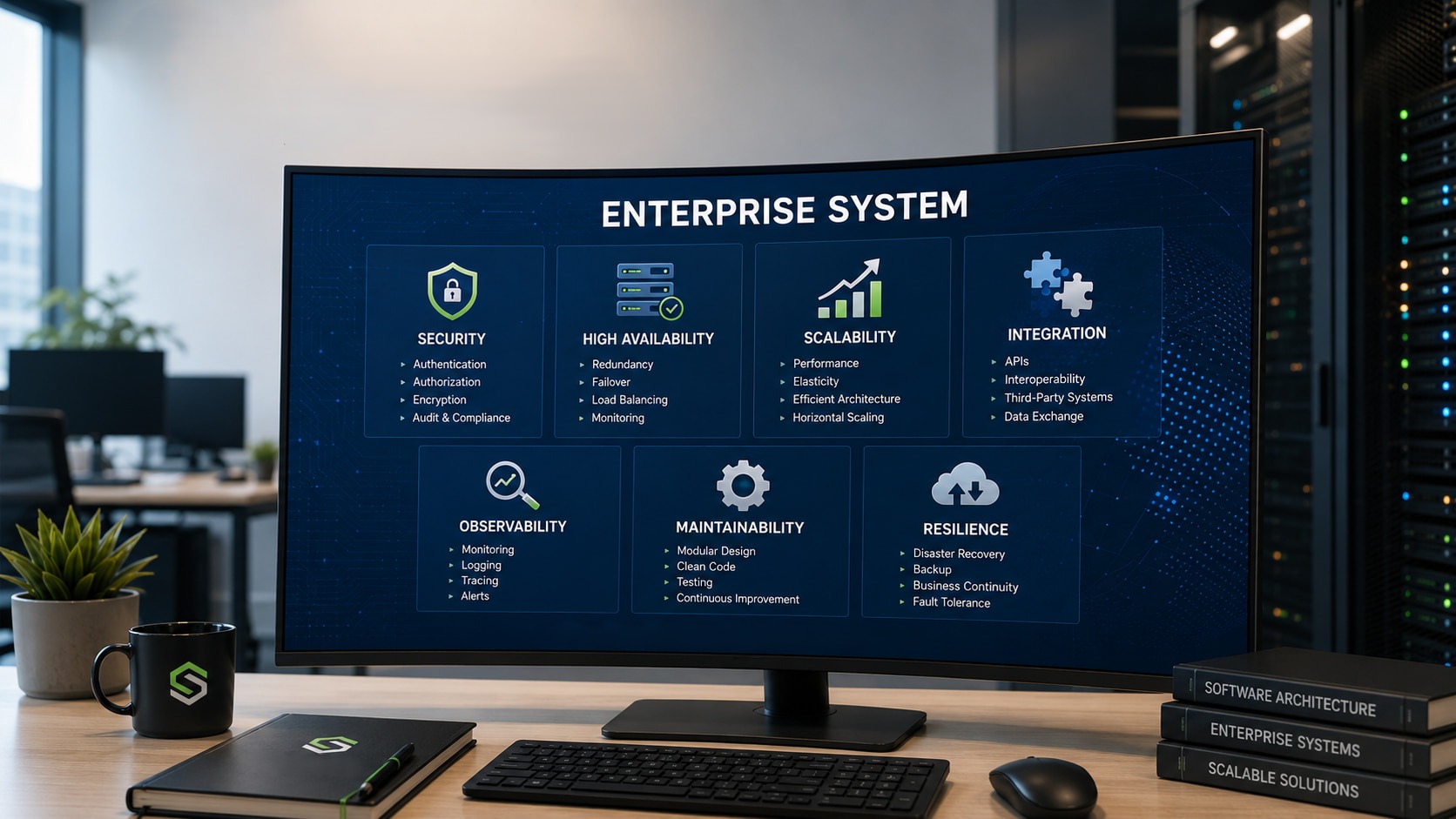
Many systems perform reliably every day. Yet only a small number can truly be considered enterprise-grade.
The difference is not defined by the user interface, the number of features, or the technologies behind the solution. It is defined by the way the system is designed to support mission-critical operations, ensure continuous availability, and evolve alongside an organization for years to come.
Enterprise software is not built simply to solve today’s challenges.
It is designed to support tomorrow’s.
Security Starts with Architecture
In enterprise systems, security is not a feature added at the end of a project. It is embedded into the architecture from the very beginning.
Authentication, authorization, encryption, auditing, and data protection all shape the way a system is designed. When security is considered from day one, it becomes an integral part of the platform rather than an additional layer attempting to compensate for architectural weaknesses.
Availability Is a Requirement, Not a Bonus
An enterprise system must be available precisely when users need it most.
Achieving this requires far more than powerful infrastructure. It depends on redundant architecture, failover mechanisms, load balancing, continuous monitoring, and disaster recovery strategies that ensure service continuity, even during unexpected incidents.
In enterprise environments, availability is not simply a technical objective.
It is a business requirement.
A System Must Be Designed to Scale
A platform may perform flawlessly with a few hundred users, but that does not mean it is ready to support hundreds of thousands.
Scalability is not simply about adding more servers or infrastructure. It depends on the architecture, the way components communicate with one another, and the system’s ability to maintain performance as demand grows.
Enterprise systems are designed for growth from the very beginning, not just for current requirements.
Maintainability Is Part of the Design
Most of the cost of an enterprise system is not created during the initial development phase.
It accumulates over the years that follow.
Software updates, regulatory changes, evolving business needs, security improvements, and new integrations all require a platform that can be maintained and enhanced efficiently.
A well-designed architecture minimizes technical debt and enables organizations to evolve without rebuilding the system from scratch.
Integration Is Essential
No enterprise system operates in isolation.
It must communicate securely and consistently with other platforms, databases, services, and third-party systems.
Interoperability is more than a technical capability.
It determines how flexible an organization can be and how effectively it can build connected, efficient business processes.
Systems Must Be Continuously Observable
A modern system should do more than simply operate.
It should continuously provide visibility into its own health.
Performance monitoring, log analysis, distributed tracing, and proactive anomaly detection enable technical teams to identify and resolve issues before users are affected.
In enterprise software, observability is not a luxury.
It is part of everyday operations.
Resilience Matters
No system is immune to failure.
The real difference lies in how it responds when failure occurs.
Enterprise systems are designed to continue operating even when individual components fail. Resilient architectures minimize disruption, isolate failures, and enable rapid recovery while maintaining service continuity.
This is one of the defining characteristics that separates enterprise software from conventional applications.
Enterprise Software Is Built with Responsibility
At ALSoft, we believe enterprise software is not defined by its complexity or by the technologies it uses. It is defined by its ability to remain secure, available, scalable, and reliable over time.
As Ermal Beqiri, founder of ALSoft, explains:
“Technology is constantly evolving. The one thing that should never change is the trust people place in the systems they use. For us, that has always been the greatest responsibility when building software.”
Enterprise software is not measured by what users see on the screen.
It is measured by everything happening behind the scenes to ensure that the system continues to operate with the same level of security, performance, and reliability, regardless of the challenges the future may bring.